
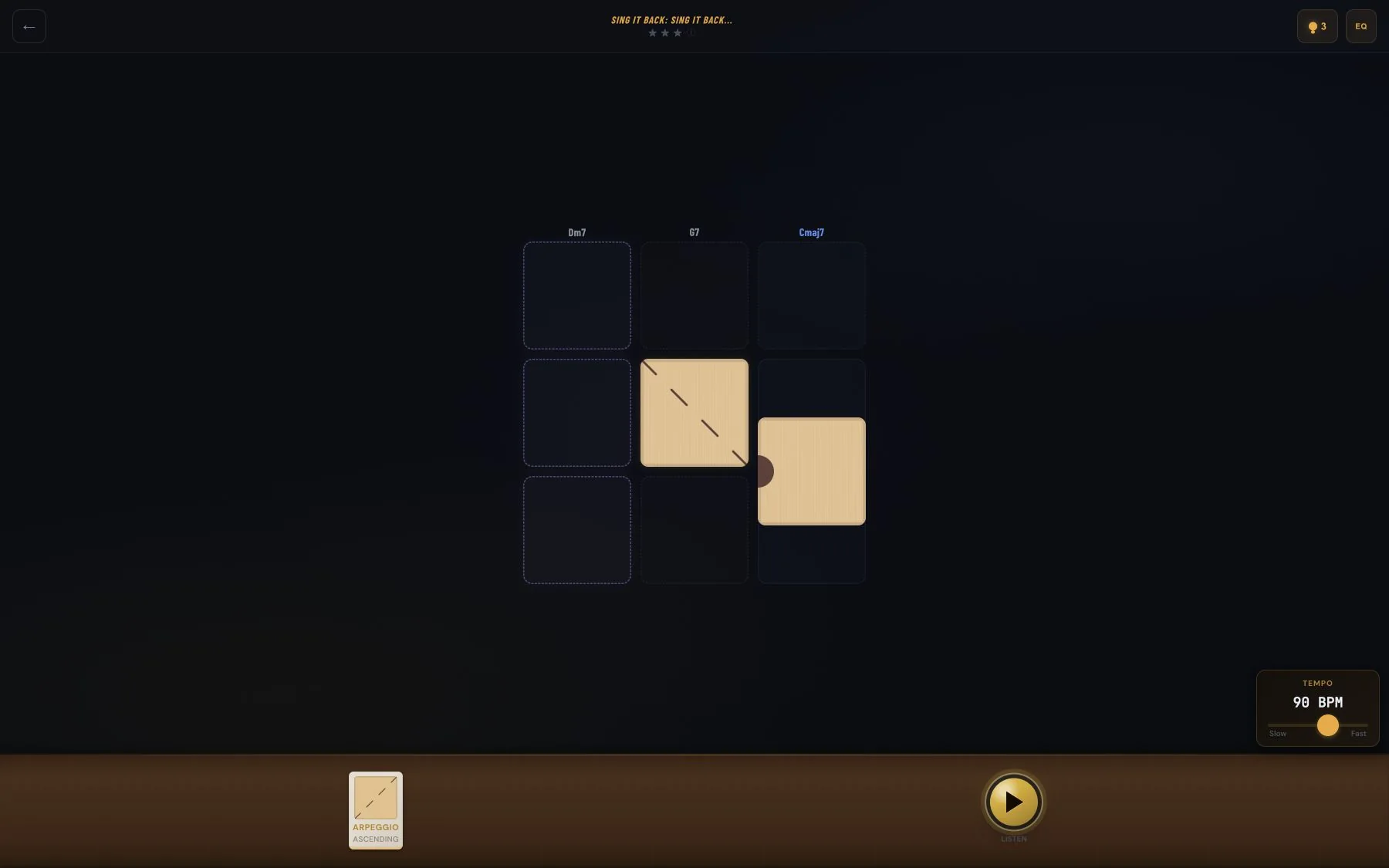
Build bebop lines by touch. Connect four-note pieces across a chord grid and hear every decision through a Rhodes-inspired instrument.
6 chapters. 80 levels. Daily missions. Composer Mode. Printable board game.
LIVE DEMO
Play Bebop Puzzle here
Drag the pieces. Hear the line. Play the full campaign.
What it does
Theory becomes touch
Arpeggios, neighbors, approaches, and enclosures become pieces.
Hear every decision
Tempo, swing, tone, drive, reverb, and tremolo make the grid sing.
From lessons to play
The campaign opens into composing, missions, and print-at-home play.
CASE STUDY
Behind the work
Turn theory into play without flattening the music.
Jazz theory often starts with notation and jargon. Bebop Puzzle had to make voice leading, approaches, and enclosures tangible—without becoming a worksheet.
Game rules, learning design, UX, sound, web engineering, levels, and release.
Independent. Built the game, audio, content, and release.
02Key decisions
- Turn jazz vocabulary into four-note pieces with clear connection rules.
- Play every move instantly through a Rhodes-inspired instrument.
- Stretch one mechanic from lessons to composing, missions, and print.
03Limits & misses
- Early concepts felt like worksheets with decorative sound.
- A valid connection could still sound weak.
- Drag and audio had to survive desktop, touch, and browser policies.
04Results
- Live at beboppuzzle.com.
- Ships 6 chapters, 80 levels, daily missions, and Composer Mode.
- The same system works as a printable board game.
05What I built
- Puzzle grammar, melodic pieces, validation, progression, and 80 levels.
- Browser game, drag interaction, synth, playback, and audio feedback.
- Composer Mode, missions, lessons, print kit, identity, and release.